

Catholic EB24 – It’s more than just numbers

7 August 2026
Why the IEU is Claiming 6%. And Why 3% Isn’t Enough.
One of the most common questions members ask is: Why is the IEU seeking a 6% annual salary increase when the employer is offering 3%?
The answer is straightforward:
Our claim is about restoring purchasing power, recognising the value of our work, and ensuring Catholic schools remain competitive in attracting and retaining quality staff. We don’t want South Australian Catholic Teachers to be the lowest paid in Australia.
The difference is much bigger than it sounds
At first glance, the difference between 3% and 6% each year may not seem dramatic, but over the life of the agreement, the gap becomes significant.
Under the employer’s proposal, salaries increase by just 9.27% compounding over three years. Under the IEU claim, salaries increase by 19.1% compounding over the same period.
For a teacher at the top of the salary scale, that means:
Every year that difference compounds — meaning members continue to fall further behind.
It’s about restoring real wages
The IEU’s claim is not arbitrary.
Since 2019, inflation has significantly outpaced salary growth. While prices have risen by around 30%. Wages in Catholic schools have not kept pace.
The analysis shows that:
- the employer’s proposal leaves employees approximately 5.4% worse off in real terms than they were in 2019.
- the IEU claim would restore purchasing power to around 2019 levels, rather than allowing the erosion of wages to continue.
This isn’t about getting ahead it is about getting back to where members were before the recent surge in the cost of living.
Even Catholic employers say wages should grow faster
There is another important point.
The Australian Catholic Bishops Conference and the Australian Catholic Council for Employment Relations argued before the Fair Work Commission that the National Minimum Wage should increase by between 4.5% and 5.0% over recent years.
Yet Catholic school employers are offering their own teachers and education support staff just 3% each year.
Members are entitled to ask:
If 4.5–5.0% is considered fair for Australia’s lowest-paid workers, why are highly qualified teachers and education support staff being offered only 3%? Are they not valued as highly?
Competitive salaries matter
An important consideration in bargaining is ensuring that South Australian Catholic schools continue to offer salaries that are competitive with those available in other Australian jurisdictions.
Experienced teachers play a vital role in our schools.
They bring years of expertise to the classroom, mentor early career teachers, lead curriculum initiatives and provide stability for students and school communities. Maintaining competitive salaries helps ensure Catholic schools continue to attract and retain these highly skilled professionals.
Under the employer’s proposal, the maximum classroom teacher salary in South Australian Catholic schools would be $123,234 from May 2026. By comparison, teachers at the top of the classroom scale in Western Australia, New South Wales and the ACT would earn around $129,000 to $130,000.
The IEU’s salary claim would position South Australian Catholic teachers alongside the highest-paid classroom teachers in Australia. This would strengthen the sector’s ability to recruit and retain experienced teachers and recognise the significant contribution they make to our schools.
Competitive salaries are about more than keeping pace with other jurisdictions. They are an investment in the quality of Catholic education, helping ensure our schools continue to attract outstanding teachers and provide students with the benefit of experienced, committed professionals.
The IEU claim is responsible
The IEU has developed its claim based on:
- restoring lost purchasing power
- maintaining nationally competitive salaries
- supporting recruitment and retention
- recognising the professionalism of teachers and education support staff
- ensuring members share fairly in the financial strength of the Catholic education sector.
Our claim is ambitious because the circumstances demand it, but it is also grounded in evidence.
After years of declining real wages, members deserve an agreement that restores the value of their work, rather than locking in another three years of falling behind.
At a Glance
Current salary: $116,160
- $8,028 below the national average
- $10,755 below the national midpoint (median)
- Ranked 7th nationally, before considering any future salary increases in other states and territories.
Employer offer: $123,234
- $954 below the national average
- $3,681 below the national midpoint
- -5.4% Real wage position under employer offer
- Ranked 6th nationally, before considering any future salary increases in other states and territories.
IEU claim: $130,517
- $6,329 above the national average
- $3,602 above the national midpoint
- +0.2% Real wage position under union claim
- Ranked 1st nationally, before considering any future salary increases in other states and territories.
IEU Reps in Catholic schools are telling their story to the FWC
If you have been reading our frequent Catholic member email updates, and reading our social media posts, you will be well aware that action is being taken by some Catholic schools through the Fair Work Commission in response to CESA refusing to budge on their 3% salary increases.
This action by members is a powerful and legal statement to CESA that they are not happy with the salary situation outlined above, and they are willing to action for better salaries – amongst other claims.
Speaking to the FWC face-to-face allows the Commissioner to hear member’s perspective of the bargaining issues firsthand.
Last week we had two IEU Sub-Branches talk with the Commissioner:
St Aloysius College Representatives
Pictured, left – right: Aaron and Tom – IEU(SA) Reps at St Aloysius College with Dan (IEU(SA) Industrial Officer) and Tim (IEU(SA) Branch Secretary
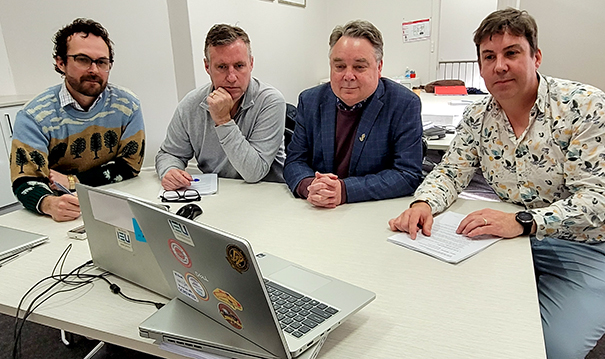
Tom summarised his message to the Commissioner as:
“Catholic Teachers in South Australia currently receive the lowest salaries of any mainland state. Our members are seeking a more competitive offer, particularly given that young teachers are frequently unable to secure bank loans for housing due to insufficient income, and are similarly unable to save for a house deposit. A number of non-members have also expressed concern that the proposed 3% salary increase is inadequate, particularly when compared with offers in other states, and given that the current offer sits below inflation. Furthermore, members have not received a pay rise in two years. 95% per cent of our subbranch have indicated they are prepared to take protected industrial action and will vote to reject the current offer, we want a better offer now!”
Aaron summarised his message as:
“Teacher workload has become increasingly difficult to sustain, and CEA is a clear example. Catholic schools rightly value co-curricular activities as an important part of school communities, but the teachers who make them possible are not adequately compensated. Goodwill should not be the business model that allows schools to provide these opportunities. If CESA values them enough to offer and promote them, it needs to properly resource the work required to deliver them. This is particularly concerning when teachers are already working well beyond their allocated hours simply to keep up with data, administration, communication with families and increasingly complex student needs and behaviours. CESA expects this work, relies on it, but does not adequately recognise it.”
St Columba College Representatives
Pictured, left-right: Tim with Misty, Tristan and Cassie (IEU(SA) Reps at St Columba College) and Dan (background).

Misty summarised her message to the Commissioner as:
“The cost-of-living crisis is placing teachers under financial strain, adding to the emotional, physical and mental pressures we already face. Planning, marking, reporting and administration simply don’t fit into the time we’re given. Teaching is becoming unsustainable without meaningful workload and conditions reform.”
Tristan summarised his message as:
“More and more tasks keep landing on our desks, but no extra time comes with them — where does it stop?”
Cassie summarised her message as:
“Working two jobs – at times up to a month without a day’s break – just to try and support myself on one income. Increasing complexity within classes due to personalised needs – no additional time to complete admin requirements, and still at 29 students to support simultaneously.”
What can you do to support these schools and yourselves?
CESA have sent updates to all their employees with the viewpoint that the IEU is stopping all employees from voting. This is inaccurate.
We are advising IEU members and their colleagues to ask why CESA won’t listen to their salary (and workload) claims.
Industrial action is a legal and valid pursuit of this answer.
We have created a Fact Sheet for members to answer your questions on what industrial action is and isn’t – read it here
The bargaining door remains open. That is why the IEU has not agreed that the proposed Catholic Schools SA agreement is ready to be put to employees. There is still an opportunity to improve the offer.
New IEU member applications from Catholic schools have been unprecedented.
Join with your colleagues in solidarity and use your voice to win change