

May Day – Pagans, Commies and Workers
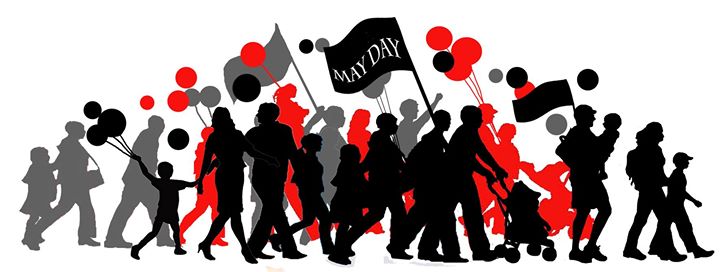
Pagan Origins
The first May Day celebrations were Roman and Medieval fertility festivals. The Romans honoured Flora, goddess of spring. The Celts celebrated Beltane. The Teutons celebrated Walpurgis. Diana, Herne, witches, The Green Man and Maid Marian were central to the various Northern Hemisphere celebrations.
May was the month of fertility and rebirth as the Sun returned. Trees were cut and brought back to become the Maypole. Couples would dance around the overtly phallic symbol (with equally overtly symbolic wreaths and baskets) to eventually become entwined in the ribbons with a potential sexual partner.
May Day was a time of sexual licence and would have resulted in quite a stirring of the village gene pool. It was a time of carefree raucous fun. Over time it became a time for satire and poking fun at local authorities, priests and lords – all worthwhile objectives in any decent society!
It is little wonder that the British Puritans banned it by Act of Parliament in 1644. When May Day returned to the public calendar after 1660 it had lost its image as an orgiastic, contemptuous defiance of social norms and controls.
Victorian England further sanitised and moralised the event into a quaint, innocent folksy festival. Sadly, conformity had emerged victorious, although I am sure there are still some practitioners of the “Old Religion” out there who still discretely celebrate the “old” festival in the “old” way.
Chicago 1886
The modern “Workers’ Day” concept of May Day originates from a much less merry and carefree time in the USA. The land of liberty has never been, and still isn’t, good at allowing workers the fundamental liberty to organise.
American workers were struggling to obtain improvements in their working conditions. The Industrial Revolution in USA had produced the same exploitative, uncontrolled, unsafe sweatshops as in other industrialised nations.
On May first 1886, national strikes were being organised in Canada and USA by the Knights of Labour in the campaign for the eight-hour day. Ten, twelve and fourteen-hour days for six days a week were the norm at the time.
On May third 1886, Chicago police fired into the crowds of protesting workers killing six and wounding many more. The next day when the workers assembled in the Haymarket Square to protest the police brutality, a bomb was thrown by an unknown agitator and, coupled with the shooting in response, left eight dead and hundreds wounded.
Eight anarchist trade unionists were arrested after many raids of activists’ homes. A show trial was held in which seven were sentenced to death and the other to fifteen years jail. Later in 1886 four were hanged with one cheating the noose – suiciding by biting on a dynamite cap. It wasn’t until 1893 that the injustice of the trial was officially acknowledged with the pardoning of all eight – unfortunately too late for the five “Haymarket Martyrs”.
In 1889, the First (Paris) Congress of the Second Socialist International selected May first as the day to celebrate the international “working man” in commemoration of the Haymarket Massacre and the ongoing universal struggle for workers’ rights. The red flag became a symbol of the blood of working class martyrs.
Modern May Day
Since then, May Day has been celebrated as the workers’ day in many countries around the world. May Day has become a symbol of a celebration of the common people by the common people and not one officially sanctioned or condoned by authorities. It is a day taken, not a day given.
With the Cold War and McCarthyism it became quite socially unacceptable to associate with events that attracted dangerous people like commies, anarchists, socialists, activists, unionists, red-raggers and a great mish-mash of assorted trouble makers.
Official “Labour Day” (or Eight Hours Day as it was) is in October in South Australia. However, May Day remains the only fixed, international recognition of working peoples’ solidarity. It has an appealing unilateralism about it that doesn’t rely on being officially sanctioned nor rely on the grace and favour of management or government.
All quite deliciously subversive eh?
2018 Adelaide Rally to Change the Rules
In the spirit of challenging the fairness of the current system, the 2018 Adelaide May Day march will be calling for the current IR system to be overhauled – The current system is broken and we need to Change the Rules