

PGS – Where is the money going
This web page is not publicly linked but it is not private. Please be aware that any link shared can be seen by anyone with the link.
Quickfind page menu
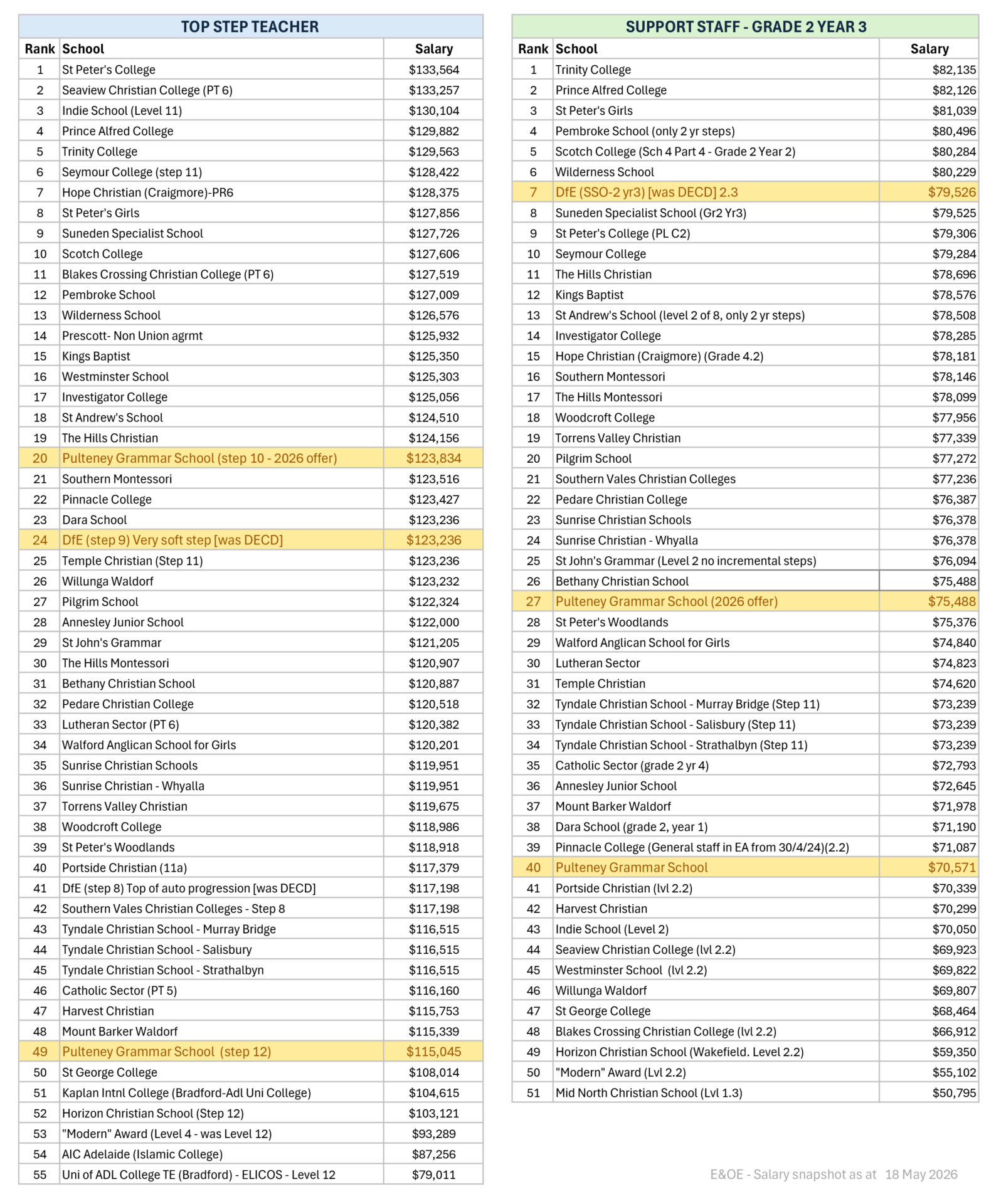
Where does Pulteney Grammar School rank compared to salaries at other South Australian schools?
Current Pulteney Grammar School bargaining status
Published in Class Action/Latest News – Friday 8 May
Bargaining Status: Close to Finalisation for Ballot
As negotiations continue at Pulteney Grammar, salary remains the unresolved issue at the centre of discussions. Following the rejection of the employer’s proposal in a recent staff straw poll, employees are angry that the employer has not come back with a revised offer that will better reflect current economic realities.
Those realities have shifted significantly. With inflation now sitting at 4.6%, many staff are feeling the impact of a sustained cost of living crisis. Against this backdrop, the proposed salary increases 4% in 2025 and 3.5% in both 2026 and 2027 are increasingly being viewed not as meaningful gains, but as adjustments that struggle to keep pace with rising expenses.
At present, a Top Step Teacher earns $115,045. Even with the proposed increases, this would rise to $128,169 by 2027. While this represents an 11% increase over three years, staff are questioning whether it truly delivers real wage growth once inflation is considered.
The issue is compounded by Pulteney’s position in the broader market. Comparable independent schools are already paying between $129,000 and $133,000, while the public sector benchmark (DfE Step 9) sits at $123,236. Pulteney’s current rates remain well below both, leaving experienced teachers thousands of dollars behind their peers.
For many, this is no longer just about competitiveness it’s about sustainability. Falling behind inflation effectively means going backwards in real terms, placing additional pressure on staff already managing higher living costs.
Professional Services staff face a similar challenge. At Level 2.2, salaries of $70,571 remain significantly below both public sector benchmarks and leading independent schools, reinforcing concerns that Pulteney is positioned closer to the lower end of the pay scale than to its peers.
At the same time, reports of substantial increases in leadership salaries have intensified scrutiny. The contrast between executive pay growth and the current offer to staff has raised broader questions about equity and priorities within the school.
With recruitment, retention, and morale all closely tied to fair and competitive pay, staff are looking for an offer that does more than maintain the status quo. In a high-inflation environment, standing still effectively means falling behind.
Until salary concerns are meaningfully addressed, it remains unlikely that the current proposal will gain the level of support needed to move forward.
Back to top