
Salary Trends Across SA Non-Government Schools – August 2026

1 August 2026
The IEU’s updated analysis of salaries at 1 August 2026 shows continued improvement across the sector, driven largely by scheduled enterprise agreement increases rather than widespread bargaining outcomes.
There are currently a number of schools where enterprise agreements are awaiting approval or implementation. These agreements contain salary increases, including a number of backdated increases that are not yet reflected in the published salary schedules.
The Catholic Schools Enterprise Agreement, when finalised, will provide back pay for members to 2025.
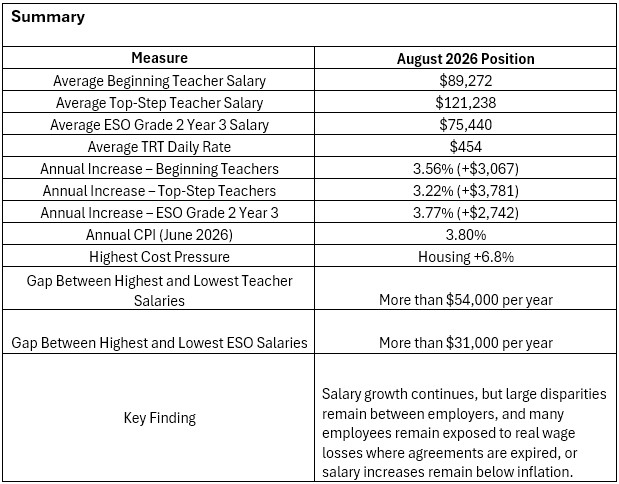
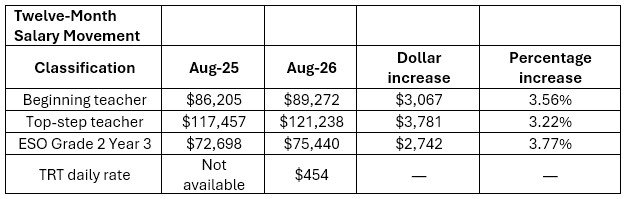
Beginning teacher salaries now average $89,272, top-step teacher salaries average $121,238, ESO Grade 2 Year 3 salaries average $75,440, and teacher relief teaching rates average $454 per day.
Compared with August 2025:
- beginning teacher salaries increased by $3,067, or 3.56%
- top-step teacher salaries increased by $3,781, or 3.22%
- ESO Grade 2 Year 3 salaries increased by $2,742, or 3.77%
However, large disparities between employers remain. The gap between the highest and lowest-paying schools remains more than $54,000 for teachers and more than $31,000 for ESOs, highlighting the continuing importance of enterprise bargaining outcomes.
Beginning Teachers
August 2026
- Average: $89,272
- August 2025 average: $86,205
- Annual increase: $3,067
- Annual increase: 3.56%
- Range: $61,418–$115,475
- Difference: $54,057
The Best
Highest paying:
- Indie School, Level 9: $115,475
- St Peter’s College: $100,757
South Australia has two schools paying more than $100,000 to beginning teachers. This remains a significant milestone for entry-level salaries at a time when housing affordability, HELP debt and cost-of-living pressures continue to impact younger workers. The increase of 3.56% over the past year represents nominal wage growth. However, it remains below the latest confirmed annual CPI figure of 3.8%.
This means the average beginning teacher salary has not maintained its purchasing power over the past 12 months. The gap between the highest and lowest beginning teacher salary also remains more than $54,000.
The school at which a beginning teacher works can therefore have a substantial impact on their immediate financial circumstances, borrowing capacity, superannuation and long-term earnings.
Top-Step Teachers
Step 10
August 2026
- Average: $121,238
- August 2025 average: $117,457
- Annual increase: $3,781
- Annual increase: 3.22%
- Range: approximately $79,011–$133,564
- Difference: approximately $54,553
The Best
Highest paying:
- St Peter’s College: $133,564
- Seaview Christian College: $133,257
- Prince Alfred College: $129,882
Top-end union-negotiated agreements continue to exceed the lowest-paying employers by more than $54,000 annually. The top-step salaries increased by an average of $3,781 over the past year, 3.22% It was also below the latest confirmed annual CPI figure.
This means that, on average, experienced teachers have received a nominal salary increase but experienced a reduction in real purchasing power.
A teacher who is paid $40,000 or $50,000 less each year is not only receiving a lower annual salary. They are also receiving lower employer superannuation contributions and reduced payments when accessing salary-based entitlements.
Over ten years, the difference between the highest and lowest-paying schools may exceed $500,000 before the effect on superannuation is considered.
ESO Grade 2 Year 3
August 2026
- Average: $75,440
- August 2025 average: $72,698
- Annual increase: $2,742
- Annual increase: 3.77%
- Range: $50,795–$82,135
- Difference: $31,340
The Best
Highest paying:
- Trinity College: $82,135
- Prince Alfred College: $82,126
- DfE: $79,526
- Suneden Specialist School: $79,525
ESO salaries recorded a percentage increase of the by 3.77% over the year.
However, this was still below the latest confirmed annual CPI figure of 3.8%.
ESO disparities also remain significant.
While many independent schools benchmark teacher salaries against the DfE, support staff salaries frequently remain well below public-sector equivalents. For many general staff, salary growth continues to lag behind the increasing complexity and responsibility of their work.
The $31,340 difference between the highest and lowest ESO salary also demonstrates that percentage increases alone will not resolve the problem.
Where a salary structure is already substantially behind the sector or national salaries , applying the same percentage increase may preserve or even widen the dollar difference.
Work is continuing through enterprise bargaining to address:
- outdated classification structures including youth wages.
- limited incremental progression
- insufficient recognition of qualifications and experience
- inadequate higher duties arrangements
- insecure employment
- salary rates that do not reflect the complexity of the work being performed
Many ESOs now perform increasingly complex work involving disability support, student health and personal care, behavioural support, literacy and numeracy intervention, and student wellbeing. Salary structures must properly recognise the skill, responsibility and increasing demands of this work.
Temporary Relief Teachers
August 2026
- Average daily rate: $454
TRT rates differ significantly between employers.
Some enterprise agreements provide a fixed daily rate, while others link the rate to a particular teacher classification or salary step. There are also significant differences in whether schools recognise a relief teacher’s qualifications and previous teaching experience.
Temporary relief teachers undertake the same professional responsibilities when placed in charge of a class, including:
- duty of care
- behaviour management
- delivery of learning programs
- compliance with school policies
- supervision of students
- professional registration requirements
Enterprise agreements should recognise the qualifications and experience of relief teachers. Where agreements provide the same rate to all relief teachers, experienced teachers may receive substantially less than the value of their normal classification.
Key Bargaining Insights
- Union agreements deliver clearly better outcomes
Top enterprise agreement schools exceed lower-paying employers by:
- Beginning teacher salaries: approximately $25,000 to $54,000
- Top-step teacher salaries: approximately $30,000 to $54,000
- ESO salaries: up to approximately $31,000
There remains a strong correlation between active IEU membership, collective bargaining and improved salary outcomes.
The strongest salary increases are generally found where members have organised, developed claims, supported workplace representatives and maintained pressure through the bargaining process.
- Annual salary growth remained below inflation
Although the average salary increases for each classification, the annual increases remained below CPI:
- beginning teachers: 3.56%
- top-step teachers: 3.22%
- ESOs: 3.77%
- CPI: 3.8%
This means that the average employee in each classification received a real wage reduction. The position is more serious for employees who received no increase or who remain covered by an expired salary schedule.
- Scheduled increases show the value of enterprise agreements
Much of the salary movement over the past year was caused by increases already secured in enterprise agreements.
An enterprise agreement provides employees with:
- certainty about future increases
- enforceable salary rates
- transparent salary progression
- access to back pay where negotiated
- a bargaining framework for future improvements
Without an enterprise agreement, employees are often dependent on employer discretion. Discretionary increases are not a substitute for enforceable wage outcomes.
- Non-union and expired agreements continue to fall behind
Flat salary structures in expired and non-union agreements continue to drive inequality across the sector. Workers covered by these arrangements have frequently experienced real wage cuts when CPI is considered. Expired agreements also create uncertainty.
Employees may not know:
- when their next increase will occur
- whether back pay will be provided
- whether the employer will bargain genuinely
- whether classifications will be reviewed
- whether the salary gap with comparable schools will continue to grow
- Percentage increases can preserve inequality
A percentage increase applied to a low salary does not close the gap with higher-paying schools. For example, a 3% increase at a school already paying $20,000 below the sector leader will not address the structural difference. In some cases, the dollar gap will continue to increase even where both employers provide the same percentage increase.
Bargaining claims must therefore consider:
- the percentage increase
- the starting salary
- sector comparators
- the total dollar gap
- the cumulative value over the life of the agreement
- ESO salaries require structural adjustment
ESO salary classification structures remain one of the clearest examples of inequality across the sector. A percentage increase will not correct a salary structure that is already $15,000, $20,000 or $30,000 behind an appropriate comparator. Enterprise bargaining must continue to pursue structural adjustments, classification reform and improved progression for education support staff.
- Collective action remains important
The salary data provide an important basis for collective action. Where bargaining produces fair outcomes, members can secure improved wages without escalation.
However, where employers:
- delay bargaining
- refuse to improve their offer
- offer increases below inflation
- refuse to provide back pay
- refuse to address structural salary inequality
- withdraw previously agreed positions
- fail to reasonably respond to union claims
members may need to consider stronger collective action.
Collective action is most effective when supported by strong workplace organisation.
This includes:
- high union membership
- active workplace representatives
- regular member meetings
- clear workplace claims
- a shared understanding
- member willingness to act together
The purpose of collective action is not action for its own sake. It is to create sufficient bargaining pressure to achieve a fair enterprise agreement.
Schools with strong union-negotiated agreements continue to lead the sector on pay, while workers covered by expired agreements, non-union arrangements or award-reliant salaries continue to fall behind.
The August figures reinforce a consistent trend across the sector:
Where members are organised, salaries are significantly higher.
Where they are not, wages stagnate or fail to keep pace with inflation.
At a time of ongoing cost-of-living pressures and workforce shortages, the evidence is increasingly clear that collective bargaining remains the most effective mechanism for improving wages and reducing inequality.
Where employers refuse to provide fair outcomes through bargaining, collective action remains an essential part of achieving change.
Note: Based on the IEU salary dataset current to 1 August 2026. Some recently approved agreements may not yet be reflected in published salary schedules. Salary comparisons depend on the identified classification, step, experience and applicable enterprise agreement.