

The Hidden Weight in Our Classrooms
Open research reveals the toll of secondary trauma on educators—and what we can do about it
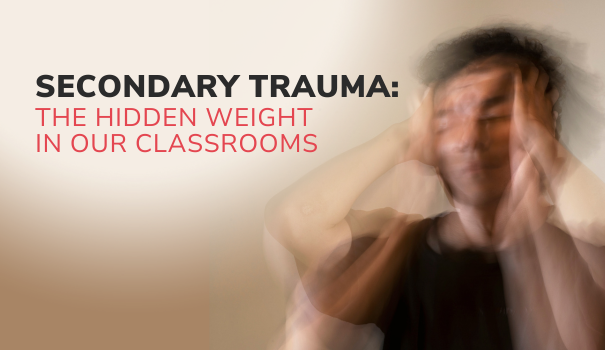
A groundbreaking national report, The Silent Cost, has revealed what many educators already know: trauma doesn’t stop at the school gate. Seventy-five percent of educators report experiencing medium to high levels of secondary trauma—surpassing even those in frontline health roles. This is not just a statistical anomaly; it reflects the lived experience of thousands of teachers, support staff, and leaders who work daily with students carrying complex emotional burdens.
Understanding Secondary Trauma
Secondary (or vicarious) trauma occurs when an individual is exposed to the distressing experiences of others. For educators, this often means hearing disclosures of abuse, observing trauma-related behaviours, and providing ongoing emotional support in classrooms that lack sufficient mental health resources.
As one member shared:
“I wasn’t in the car accident. I wasn’t the child living in fear of domestic violence. But I was the one holding space for it. I was the one doing the reports, managing the behaviour, showing up the next day.”
The emotional toll is not just anecdotal. According to The Silent Cost report, over half of respondents reported symptoms of depression related to trauma exposure. Nearly 40 percent were considering leaving the profession.
What the Research Confirms
A 2023 national review published in Frontiers in Education by Oberg, Carroll, and MacMahon—licensed under Creative Commons—provides a clear academic framing for what has, until now, remained largely invisible.
The study highlights:
- A rise in compassion fatigue and secondary trauma among Australian educators
- A lack of adequate supervision or structured wellbeing support for staff
- A growing mismatch between professional role and emotional expectation
The authors note that teachers are being asked to “absorb trauma without any shield,” often stepping into roles traditionally reserved for psychologists, counsellors or social workers—without the corresponding support structures.
A 2025 study by Phillips and Anderson, published in the Journal of Psychologists and Counsellors in Schools, identified key protective factors against secondary trauma: peer support, self-care practices, access to clinical debriefing, and the ability to set professional boundaries. These are not extras—they are safety mechanisms, and they must be embedded into our industrial and professional settings.
What Needs to Change
The evidence is clear: systemic change is required. Personal resilience, while important, is not sufficient to prevent long-term harm.
The IEU believes the following must be prioritised in collective bargaining and school-level planning:
- Explicit recognition of secondary trauma as a workplace health and safety risk
- Provision of regular professional supervision for staff in high-exposure roles
- Inclusion of wellbeing and trauma-informed structures in workload planning
- Access to psychological support through Employee Assistance Programs or external providers
As one union officer noted:
“We cannot fix a system-wide mental health crisis with mindfulness posters and morning tea. We need structural, industrial solutions—and we need them now.”
How are things weighing on you?
The mandatory reports. The disclosures. The quiet confessions from students carrying more than any child should. One story after another: neglect, abuse, family violence, criminal involvement. The violent behaviour you witness in the classroom.
Each time you do what you are trained to do. And carried on.
The school may be very good at putting in place supports for the children and students, but often, the staff are forgotten.
For the children and students in our class we are the first responders in a child life .
It is the teacher that might notice when things aren’t right and providing ongoing care and stability. Over time, this emotional labour can accumulate especially when schools lack the resources, staffing, and support structures to share the load.
When something goes terribly wrong, then the teacher in their trusted role may have to lead the class and community through trauma.
Support Yourself Against Vicarious Trauma
Self-Awareness
- Recognise signs of vicarious trauma in oneself, such as emotional distress or changes in behaviour, and acknowledge the need for self-care.
Practise Stress Management
- Implement stress-reduction techniques such as deep breathing exercises, meditation, or progressive muscle relaxation to manage stress levels.
Establish Self-Care Routines
- Incorporate self-care practices into daily routines to promote physical and emotional wellbeing. This could include regular exercise, spending time with loved ones, healthy eating habits, spending time in nature, adequate sleep, and mindfulness or relaxation techniques.
Set Boundaries
- Establish clear boundaries between work and personal life to prevent overexposure to traumatic content. Limit exposure to distressing material outside of work hours if possible.
Seek Support
- Connect with colleagues, friends, or a support network to discuss experiences and emotions related to vicarious trauma. Consider seeking professional help, such as support from your EAP (Employee Assistance Program), if needed.
Manage Workload
- Prioritise tasks and manage workload effectively to prevent burnout and overwhelm. Delegate tasks when possible and communicate with superiors about workload concerns.
Union Action: What Can Be Done
Connect with Colleagues
- Organise a union meeting or wellbeing discussion in your workplace. Use the report to raise awareness and support collective action.
Push for Trauma-Informed Workplaces in Bargaining
- Advocate for clauses that recognise secondary trauma as a workplace risk.
- Demand access to professional supervision and psychological support as part of workload provisions.
The IEU is here to assist you. Contact our office if you have any questions – 8410 0122 or enquiries@ieusa.org.au
Sources
The Silent Cost: Impact and management of secondary trauma in educators (2025)
Compassion Fatigue and STS in Teachers, Oberg et al., 2023 – Frontiers in Education (CC BY 4.0)
Protective Factors for STS After Student Suicide, Phillips & Anderson, 2025 – Journal of Psychologists and Counsellors in Schools (CC BY)
Wellbeing Needs of Australian Teachers, Lemon & Turner, 2024 – Australian Educational Researcher (Open Access)