

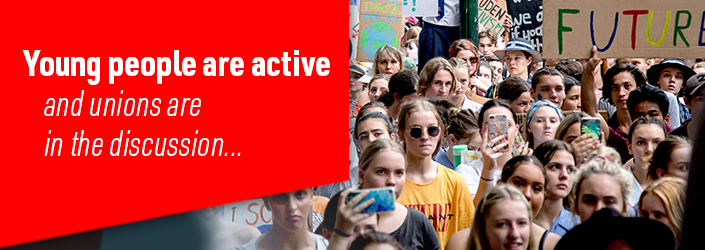
Young people are active and unions are in the discussion.
And rightly so…
Fresh off the back of School Strike 4 Climate, #enoughisenough and March 4 Justice, the world is seeing a higher level of activism in response to world issues ignored by governments deemed ‘out of touch’ and not achieving real outcomes for climate or women. US workplaces are also starting to consider their own activism, typified by the introduction of an Executive Order by President Biden in the United States to establish a White House Task Force on ‘Worker Organization and Empowerment’.
Amanda Tattersall of Sydney University’s Sydney Policy Lab said young people are responding to their world – and its unprecedented challenges – with activism, and it is on a scale and in a manner not witnessed in our recent history. “There hasn’t been this level of activism in quite a while – potentially a generation.”
Joining a union is just one form of collectivism.
“President Biden and Vice-President Harris have long championed workers’ rights. As the President has said: America was built by the middle class, and unions built the middle class. Throughout our country’s history, unions have been the driving forces for advancements in workers’ rights and improved living standards for union and non-union workers. They have fought for higher wages, greater job security, safety and health laws, essential benefits like health insurance and retirement plans, and protections from discrimination and sexual harassment for millions of workers across the country.”
Declaring an Executive Order doesn’t equate to union membership becoming more widely accepted. Big business is still likely to push back against the workers. However, if government enforces the right of workers to unionise in any business that supplies to the government, this gives workers the chance to collectivise with government encouragement.
Why is collective action important?
Young people have realised the contribution their activism can make is not only real but necessary. “Young people are doing the work. We are leading,” said 26-year-old Senator Jordan Steele-John.
Today’s youth are well-informed, socially aware, and inspired. Margaret Thanos and Olivia Causer note: “We want to see change in the world we live in, we want our voices heard and we need to have a say in the policies and decisions that are directly affecting our lives, presently and in the future. There is a new generation of voters and if they want to win us over, the government needs to heed the concerns we deem most pressing”.
Holding the government to account through collective action may not generate instant results but the action itself inspires more people to join the protest. As these numbers swell, the media will follow and the government has little option but to take notice.
In the same manner, if a majority of workers act collectively for their own future and workplace changes, schools will have to listen. Workers working together gives your school the opportunity to improve conditions, fix issues that are overlooked and ensure your workplace is a safe place.
Find out more about collective action in the linked sources below. Speak to the IEU Rep at your school and ask non-member colleagues to join the IEU and organise collectively for each other — they can read more about IEU membership benefits at our website: https://ieusa.org.au/membership-information/membership-benefits/
Sources: