

EA Updates Around the Sectors – October-November 2026

As we near the end of the 2026 school year, your union officers are still involved in bargaining with many school employers.
Here is a snapshot of bargaining. Be sure to stay informed and participate in the IEU Sub-Branch at your school. Your voice matters.
Woodcroft College
This Enterprise Agreement (EA) is still in the Fair Work Commission (FWC) awaiting approval.
Prince Alfred College – Early Learning Centre
This agreement was successfully voted on and has been filed with the FWC for approval.
Garden College
We have now had four bargaining meetings.
Agreement:
- Temporary Relief Teacher (TRT) rates: existing staff get paid at their step plus 25% casual loading.
- Camp allowance $200 per night.
- Paid partner leave of 10 days and superannuation paid on parental leave.
- Long Service Leave access after 7 years.
- 198 days of attendance agreed.
Outstanding:
- Pay and classifications – members are seeking 4.5%, 4.25% and 4% in pay over the next three years.
- We have provided a professional development clause for the College to consider.
- The College has offered 12 weeks Parental Leave, we have asked for 14 weeks.
- Paid special and family events leave we seek 3 days
- Cultural Leave – we have provided a clause for the College to consider in relation to Eid.
- There are a large number of workload matters that are still being discussed.
- Work health and safety (WHS) matters still being discussed.
Thank you to all members for their prompt answering of our survey.
Our next EA meeting is Monday 7 December 2026.
Kings Baptist Grammar School
This negotiation is fairly slow, with a large number of claims and many individual bargaining representatives at the table.
The School has made a pay offer of 4%, 3.75% and 3.75%.
We continue to work on the workload claims
We have had agreement in relation to additional paid Special Leave of 4 days which is sector-leading. This allows members to use leave for wellbeing and mental health, family responsibilities and significant events, cultural and religious observances, health related appointments, and other circumstances approved by the principal. Leave can be taken in half days.
Please complete the survey you were sent on 16 November 2026.
We will also be aiming to meet with School Assistants to discuss their claims in the next few weeks.
St George College
Thank you to the members who completed the survey this week.
Wages
The College is currently seeking board approval of a pay offer. We have expressed member’s views that 4%, 3% and 3% does not go far enough to address the wage gap between the College and other like schools. We have further expressed the substantial wage gap for support staff.
Parental Leave
Parental Leave has increased to 16 weeks and agreement to pay superannuation.
Family and Special Events Leave
The College has not agreed.
Teacher Workload
The College has agreed to a face-to-face teaching load of 21.66 hours per week. We are currently working on a clause for payment if you go over.
Position of Responsibility (POR)
The POR claim is still being negotiated.
Co-curricular Activities
An individual bargaining representative at the table has raised Co-curricular Activities. If you have any thoughts on Co-curricular Activities, please contact our office.
Graduate Teacher Support Policy
The College is working on a Graduate Teacher Support Policy.
Camp allowance
A camp allowance of $175 has been agreed.
First Aid Allowance
A first aid allowance increase has been agreed – increasing to $1600 (previously $1000)
Our next meeting on 1 December 2026 we will discuss Early Learning Centre staff conditions.
Westminster College
We have entered into a Memorandum of Understanding (MOU) in relation to the commencement of bargaining next year. Zerebar (IEU Organiser) and Emma (IEU Industrial Officer) will organise to meet with members before the end of the year to discuss bargaining.
Scotch can do better: fair pay for every employee
Scotch College staff deserve an agreement that restores purchasing power, delivers competitive salaries and properly recognises their skills and responsibilities. The employer’s current salary offer falls short.
The IEU is seeking increases of 6% from February 2027, 5% from February 2028 and 5% from February 2029; a compounded increase of 16.87% alongside improvements to classifications, workload and employment conditions.
The claim reflects the pressures facing the whole workforce and the need for Scotch to give staff remuneration greater priority.
Resources to support a stronger offer
The My School figures show Scotch’s net recurrent income per student is almost identical to St Peter’s College, and higher than Pembroke’s.
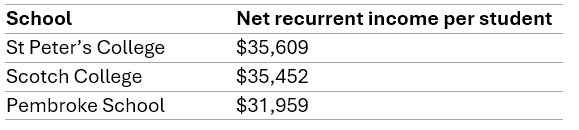
Scotch receives approximately 10.9% more per student than Pembroke while receiving only 0.44% less than St Peter’s.
Competitive resources should mean competitive salaries
Scotch is falling behind key schools under the current offer.
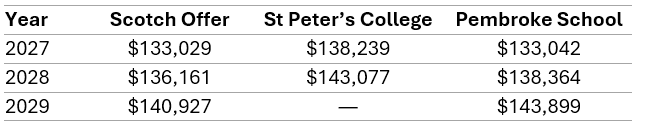
Annual top-step teacher salaries in February
By 2028, Scotch’s top-step teachers would earn $6,916 less than their counterparts at St Peter’s, despite the schools receiving almost identical recurrent income per student.
By 2029, Scotch would sit $2,972 behind Pembroke and just $277 receiving substantially more income per student
Staff are entitled to ask why Scotch’s financial position is not translating into a more competitive salary offer.
Staff have already lost purchasing power
When we look at the Scotch College salary increases and compare them to the Consumer Price Index (CPI) between 2022 and 2026 we see that there has been a reduction in wages in real terms .

On this comparison, purchasing power fell by approximately 7.63%. Restoring the starting relationship between salaries and prices would require an increase of approximately 8.26% above the 2026 salary rate.
The proposed 4.25% increase in 2027 would not repair that accumulated loss, even before allowing for further inflation.
Meanwhile, senior school tuition fees increased from $30,360 in 2024 to $34,040 in 2026 an increase of 12.12%, compared with a compounded teacher salary increase of 7.12% across 2025–2026.
Members deserve an explanation of how additional fee revenue has been allocated and why staff pay has not received greater priority.
Additional Commonwealth funding in 2027
Scotch’s Commonwealth recurrent funding is projected to rise from approximately $6.33 million in 2026 to $6.85 million in 2027 — an increase of approximately $515,000 or 8.13%.
That increase occurs despite a reduction in the College’s Commonwealth share of the funding benchmark. Commonwealth funding is then projected to remain broadly unchanged in dollar terms through 2029. These projections exclude South Australian Government funding.
The additional revenue in 2027 should form part of a transparent discussion about the College’s capacity to improve its offer.
Fair pay and classifications for professional staff
The IEU’s claim covers the whole workforce, including Professional Staff Grades 1–4.
The Grade 2 comparison 1 May 2026 shows Scotch below several other schools.
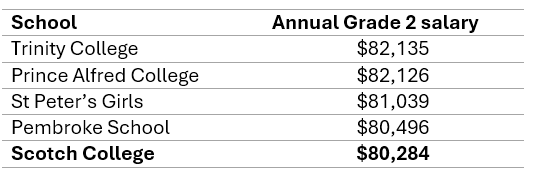
Scotch’s rate trails Trinity by $1,851 and Prince Alfred College by $1,842. While comparisons must account for duties, hours and classification requirements, these gaps reinforce the need for a thorough review.
Professional and support staff need classifications that recognise the work they actually perform: their qualifications, skills, autonomy and responsibility.
The IEU is seeking:
- A consistent reclassification process, with regular role reviews, clear decision timeframes and access to dispute resolution.
- Timely payment at the correct classification.
- Removal of junior rates, so employees receive the adult rate for the work they perform.
- Meaningful career progression across classroom support, administration, operational services, nursing, wellbeing, preschool and childcare roles.
Recognition for early years and OSHC employees
Early childhood and outside school hours care (OSHC) employees carry significant responsibility for children’s safety, learning and development. Their pay and classifications must recognise the complexity of that work, including regulatory obligations and leadership duties.
The IEU seeks a review of preschool and childcare classifications, with clear career progression and the same reclassification rights as other support staff.
The union also seeks an enforceable requirement for Scotch to access the Commonwealth Worker Retention Payment for all eligible services and employees and pass on the full benefit. The payment must be additional to negotiated agreement increases and must not be absorbed into, or substituted for, those increases.
A stronger agreement for everyone
The IEU’s proposals also seek stronger starting salaries and simpler progression for teachers, recognition of relief teachers’ experience, improved casual loading and employment security, better allowances and sustainable workloads.
Scotch’s reputation rests on the work of its staff. That contribution deserves competitive pay, fair classifications and working conditions that support a sustainable career.
Members can strengthen the campaign by staying involved, talking with colleagues and supporting the push for a better agreement.
Tyndale Christian Group of Schools
IEU delegates have collated a significant list of member concerns with the significant concerns about the proposed agreement. To date the concerns are over 56 pages in length.
The IEU will write to the employer seeking resolution. If these matters remain unresolved, the union will seek FWC assistance through a section 240 bargaining dispute.
Members’ concerns extend well beyond salary:
- Salary increases, back pay and commencement.
Members consider the proposed increases are not competitive and the salary offer does not address loss in real earnings.
They want the stated commitment to maintain parity or relativity with Department for Education (DfE) salaries written into the agreement.
They also seek clarity about commencement, nominal expiry, when particular provisions take effect, and whether salary increases, allowances and reclassification outcomes will apply retrospectively to 2026.
- Workload, stress and burnout.
Planning, assessment, administration, parent communication and student support demands continue to increase. Members report working longer hours, reducing their employment fraction, taking leave or considering leaving. Members want an agreement that addresses these concerns.
- Timetable changes.
Members are concerned that the proposed 1,420-minute model could redistribute work rather than reduce it, requiring the same curriculum and assessment in less lesson time while increasing pastoral preparation. They want enforceable protections for teaching allocations, preparation time, meal breaks, yard duties and relief obligations.
- Genuine consultation.
Members report that some representatives, particularly IEU Representatives, were excluded from timetable discussions. Alternatives were not meaningfully considered and decisions were presented as non-negotiable. They are also concerned about changes being communicated to parents before outstanding bargaining issues are resolved.
- Class sizes and student needs.
Members report that increasing disability, behavioural, medical and learning support needs have not been matched by sufficient staffing and resources. They seek class limits and Education Support Officer (ESO) allocations that reflect class complexity, transparent allocation processes and consultation before classes are formed. Members reject any suggestion that safe working conditions should be negotiable.
- Specialist subject protections.
Outdated subject names create uncertainty about applicable class limits. Members want explicit coverage of Food and Hospitality, Child Studies, Design and Technology, and Product Design, with limits reflecting facilities, equipment and safety requirements.
- Lost preparation time.
Relief lessons, events and other activities remove non-contact time while often creating additional work. Members seek replacement time or appropriate compensation.
- Education Support Officer reclassification.
Members are frustrated by review commitments carried across successive agreements. They want classifications that recognise actual duties, independence, qualifications and responsibility, including Diverse Learning and mainstream support roles. Progression, recognition of existing service and qualifications, consultation and implementation arrangements remain unresolved.
- Additional hours and allowances.
Members seek clear rules covering the reported 200-hour annual co-curricular expectation, recording additional work, holiday availability for wellbeing staff, camp payments and overnight interruptions, and eligibility and payment arrangements for first aid and toileting allowances.
- Part-time work and calendar changes.
Members want proportionate meeting and co-curricular obligations, consolidated working patterns and a clear right to return from temporary reduced hours. They also seek protection of the three-week midyear break, fair arrangements for Early Learning Centre (ELC) staff working during holidays, and clarity about requirements for support staff to accrue time off in lieu (TOIL) or take unpaid leave.
- Calendar changes.
Members seek protection of the three-week midyear break in the agreement, fair arrangements for ELC staff required to work during school holidays, and clear provisions governing any requirement for support staff to accrue TOIL or take unpaid leave during school closures.
- Leadership responsibilities and release time.
Members want current job and person specifications, clearly defined responsibilities and guaranteed minimum leadership release time in the agreement. Responsibilities must be reviewed and made measurable so allocated time reflects the work required.
These concerns will inform the IEU’s response. Members are seeking clear, enforceable provisions that improve salaries, reduce workload and recognise the responsibilities of teaching and support staff.
Southern Vales Christian School
Bargaining for a new enterprise agreement at Southern Vales Christian School begins this Thursday, with the first meeting between the IEU and the school.
With the announcement of the restructure of the school, and closure of services at Aldinga, the claim will focus on job and security and increased redundancy provisions
The IEU log of claims also seeks competitive salaries that restore purchasing power, stronger workload protections and fair recognition of professional and support staff skills and responsibilities.
Key claims include reduced face-to-face teaching, protected preparation time, improved classifications and reclassification processes, stronger job security, better leave and allowances, and meaningful consultation before workplace changes.
The claims also seek improved pay for early years and OSHC employees, including access to the Commonwealth Worker Retention Payment for eligible staff.
Members’ involvement will be central to securing a stronger agreement for every employee.
Kaplan International
Nine meetings in and we have gone through all claims, Kaplan have responded and presented their claims. Salary remains the hot issue. Kaplan’s offer of 3%, 2.5% and 2.5% is clearly below CPI. The inclusion of Kaplan policies relating to Domestic and family violence of 15 day paid, Volunteer leave, Paid Parental Leave, Study Leave, Gender Affirmation Leave and Wellbeing leave, amongst others is welcome.
Pinnacle College
Bargaining has concluded and the document will go to access and a vote shortly. Reps have worked diligently representing members and have won a number of significant improvements.
Salaries have been agreed that lift up General staff but also allow the College to overcome tight financial constraints in the short term.
Salaries (from the first pay period on or after 1 February)
- Teachers: 3.0% (2027), 3.5% (2028), 4.0% (2029)
- General Staff: 5.0% (2027), 3.5% (2028), 4.0% (2029)
Significant improvements to conditions include:
Family Friendly
- Paid Parental Leave increased from 15 to 16 weeks, with the qualifying period reduced from 2 years to 12 months.
- Partner leave doubled from 5 to 10 school days.
- Inclusion of 2 days paid Special Family Events Leave per year.
- Inclusion of 3 days paid Reproductive Health Leave per year, plus the right to request flexible work for reproductive health issues.
- Inclusion of stillbirth provisions, so paid parental leave remains available.
- Inclusion of breastfeeding and lactation facilities and arrangements.
- Family and domestic violence updated clause to provide access to paid leave for all including casual employees.
Wellbeing and Workplace Rights
- Inclusion of a Right to Disconnect clause.
- Pay Day Superannuation, so superannuation will now be paid fortnightly.
- Updated workplace delegate rights, which gives Reps greater standing and provides Rep training leave for up to 5 days’ paid initial training and at least 2 days each year after.
Teachers
- Face-to-face teaching load set at up to 22.5 hours per week (full-time).
- Relief lessons beyond a teacher’s ordinary load offset within 3 weeks or paid at the casual rate.
- Early Career Teachers (Band 1, Level 4 and below) receive 2 additional release periods per week and an allocated mentor.
- Inclusion of a Mentor Teacher Allowance of $1,000 per mentee per year.
- Camp Allowance increased to $150 per night and indexed to wage increases.
- AST (Advanced Skill Teacher) replaced by Highly Accomplished ($9,000) and Lead Teacher ($15,000) allowances, indexed, and available to Band 2 position holders on a sliding scale.
General Staff
- Higher initial salary increase to close the gap with other schools.
- Inclusion of a broad range of allowances including First Aid ($1,000 p.a.), Toileting ($750 p.a.) and On-call and Recall.
- New Classroom Support and Wellbeing Services classifications (Lead Learning Support Officer and Student Wellbeing Officer).
- Formal induction and professional development for Level 1 employees.
- Redundancy pay maintained at 16 weeks for more than 10 years’ service instead of the NES provision which drops to 12 weeks.
- New partial redundancy protections in line with those that teachers already had.
Mount Barker Waldorf School
Negotiations have commenced and the IEU has presented members claims. Next meeting we will receive the employer response. A number of independent bargaining Reps are attending but have indicated that they will not present their own claims and will rely upon the IEU member claims. Some key claims include:
- Salary – Seeking 5%, 5% and 4% increases for 2027-2029
- Paid Parental Leave to be available for all staff, rather than just permanent staff as is the current case
- Still Birth and Miscarriage Leave
- Foster Parent Leave
- Increase in spouse and partner leave
- Long Service Leave accessible after 7 years
- Family and Special Events Leave
- Updated clauses for Domestic and Family Violence leave
- Reproductive Health Leave
- Breastfeeding and lactation breaks
- Right to Disconnect
- Updated Workplace delegates clause
- Reduction in notice period that teachers have to give (currently 10 term weeks, which means that someone leaving at the end of the year needs to give notice by mid-September)
- Workload limitations around part-time teachers and the number of days over which their classes can be scheduled
- Non-Instruction Time (NIT) recorded and repayment for any missed NIT within a three week period.
- Band two positions – removal of 1A and move all 1A to level 1
- Partial redundancy for support staff
- Access to Time Off in Lieu for support staff
Sunrise Schools and ELC
Sunrise Schools agreement was recently voted up and proceeded to the FWC who with some undertakings has approved. A number of apparent voting irregularities relating to the Whyalla campus voting were resolved through the process.
Southern Montessori
Bargaining will commence soon. Members are developing a log of claims.
Published 24 November 2026
